Onboarding Email Templates for SaaS, Mapped to Triggers
Nine copy-ready SaaS onboarding email templates, each mapped to a real product trigger, with subject lines, a sequence timeline, and deliverability setup.
 Junaid KhalidAugust 4, 202616 min read
An onboarding email template is a reusable email you send a new user after signup to move them toward their first real win with your product. This page gives you nine copy-ready SaaS onboarding templates, but with the one thing almost every template roundup leaves out: each template is mapped to the specific product behavior that should trigger it, not to a fixed day on a calendar. That mapping is the difference between an onboarding sequence that lifts activation and a slow drip that annoys the users who already succeeded.
A note on scope, because the search results for this term are split. Half of them are about new-hire, HR onboarding (welcoming an employee to the team). This guide is about the other half: SaaS user onboarding, helping a person who just signed up for your software reach value fast enough to keep paying. If you are here for the HR version, this is not it. If you run a SaaS product and want templates that actually fire on what users do, read on.
Key takeaways
- A good onboarding email template is nothing without a trigger. Every template below names the exact event that should send it (signed up, activated, went quiet, trial ending), so the right email reaches the right user.
- The canonical SaaS onboarding set is roughly nine emails: welcome, activation nudge, feature spotlight, social proof, personal check-in, help offer, trial-expiration, last-chance, and post-conversion. You will not send all nine to every user.
- How many emails should a sequence have? Match it to your trial length and activation milestones, not a round number. A 14-day trial usually justifies five to eight emails; a behavioral sequence sends fewer to users who activate early.
- Onboarding email is lifecycle mail, not transactional, so it has to earn the inbox. Authentication (SPF, DKIM, DMARC) and a clean sending reputation decide whether any of these templates land.
- Copy every template below verbatim, swap in your product specifics, and wire the trigger described under each one.
What is an onboarding email?
An onboarding email is an automated message sent to a new user after signup to help them reach their first meaningful outcome with your product. In SaaS, the effective ones are behavioral: they fire on what the user does or fails to do inside the product, rather than on a fixed schedule. A welcome email greets a brand-new signup; the rest of the onboarding sequence reacts to whether that user activated, stalled, invited a teammate, or let the trial run down. Onboarding is the whole sequence, not a single send, and its job is to shorten the time between "I signed up" and "I got a result."
How to write an onboarding email that works
Before the templates, the rules that make any of them work. Strong SaaS onboarding emails share five traits:
- One email, one job, one call to action. The fastest way to kill an onboarding email is to stuff it with five links. Name the single next action and make it the only thing to click.
- Write the subject line for the user's actual state. "Getting started tips" is generic. "Your dashboard is empty. Here is the 2-minute fix" names the exact situation the user is in, which is only possible when the email is triggered by behavior.
- Sound like a person, not a product. Sign from a real name. Short, plain, and human beats a polished template with ten brand colors.
- Lead with their outcome, not your feature. Users do not care that you shipped a feature; they care about the result it gets them. Frame every email around what they walk away with.
- Keep the design light. A heavy, image-only HTML email is more likely to trip spam filters and render badly. Plain-ish text with one clear button often converts better and lands more reliably.
The nine SaaS onboarding email templates, mapped to triggers
Here is the full set. Copy each one, replace the bracketed placeholders with your product specifics, and set the trigger described under it. The trigger is the load-bearing part: it decides who gets the email and when.
1. Welcome and first step
Trigger: the signup event fires (a new account is created). Subject: Welcome to [Product]. Here is your first 2 minutes.
Hi [First name], Thanks for signing up for [Product]. The fastest way to see what it does is to [single first action, for example "connect your first data source"]. It takes about two minutes. [Button: Do the first step] If you get stuck, just reply to this email. A real person reads it. [Your name], [Product]
One line of welcome, one CTA to the single action that starts them toward activation. No feature tour, no menu of options.
2. Activation nudge
Trigger: 48 hours after signup, only if the activated event has NOT fired. Subject: You are one step from your first [outcome]
Hi [First name], I noticed you have not [specific undone action, for example "connected a data source"] yet. That is the one step that gets you to [the outcome], so I wanted to make it easy. [Button: Connect in one click] Anything blocking you? Reply and tell me. I will help.
This email should never reach a user who already activated, which is exactly why the trigger checks the activated event before sending.
3. Feature spotlight
Trigger: activated fired, but a second_key_action has NOT fired within four days. Subject: The one thing most [Product] users do next
Hi [First name], Now that your [first result] is live, here is the move that makes it stick: [the single most valuable second action]. Here is a 90-second walkthrough. [Button: Try it]
Adoption is the stage most onboarding sequences skip. This template exists to turn a one-time activation into a habit by pointing at the second meaningful action.
4. Social proof
Trigger: day 5 of the trial, for users in the "activated" segment. Subject: How [similar company type] uses [Product]
Hi [First name], A quick example in case it is useful. [Customer or use-case, generalized], a team a lot like yours, uses [Product] to [specific outcome]. Here is the short version of how they set it up. [Link: Read the 3-minute version]
Keep this honest. Reference a real use case or a generalized one, never a fabricated customer or invented number.
5. Personal check-in
Trigger: day 6 of the trial, any segment. Subject: How is [Product] going so far?
Hi [First name], I am [Your name], I work on [Product]. No pitch here, I just want to know: is this doing what you hoped, or is something in the way? Reply and let me know. I read every one.
A plain-text, human-signed email with no button. This is often the highest-reply email in the whole sequence, and the replies tell you exactly where users get stuck.
6. Help offer
Trigger: activated has NOT fired by day 7 (the user is clearly stuck). Subject: Stuck on [Product]? Let me unstick you.
Hi [First name], It looks like getting started has not clicked yet, and that is on us, not you. Two options: grab a 15-minute setup call [link], or reply with what is confusing and I will send you the exact steps. [Button: Book 15 minutes]
The stuck-user catch-all. It only fires for people who never activated, so activated users never see a "need help?" email they do not need.
7. Trial expiration
Trigger: trial day 3 before expiry, only for the "activated" segment. Subject: Your trial ends [day]. Keep your [work] going.
Hi [First name], Your [Product] trial ends [day]. You have already [specific thing they built or achieved], and picking a plan keeps all of it live and running. [Button: Choose a plan] Questions about which plan fits? Just reply.
Notice this only goes to users who activated. Asking a user who never saw value to pay is wasted; asking a user who built something real to keep it is the strongest conversion moment you have.
8. Last chance
Trigger: trial expiry day, for activated users who have not upgraded. Subject: Last day: your [Product] account pauses tonight
Hi [First name], Today is the last day of your trial. After tonight your account pauses, but nothing is deleted. Upgrade now and everything picks up exactly where you left off. [Button: Keep my account active]
One decision, one button. No new information, just the deadline and the reassurance that their work is safe.
9. Post-conversion welcome
Trigger: the plan_upgraded or subscription_started event fires. Subject: You are in. Here is how to get more out of [Product].
Hi [First name], Thanks for going with [Product]. Now that you are on [plan], here is the one power feature most people miss in week one: [feature and the outcome]. [Button: Set it up]
Upgrading fires this and should immediately stop every trial and nudge sequence, so a paying customer never gets another "your trial is ending" email.
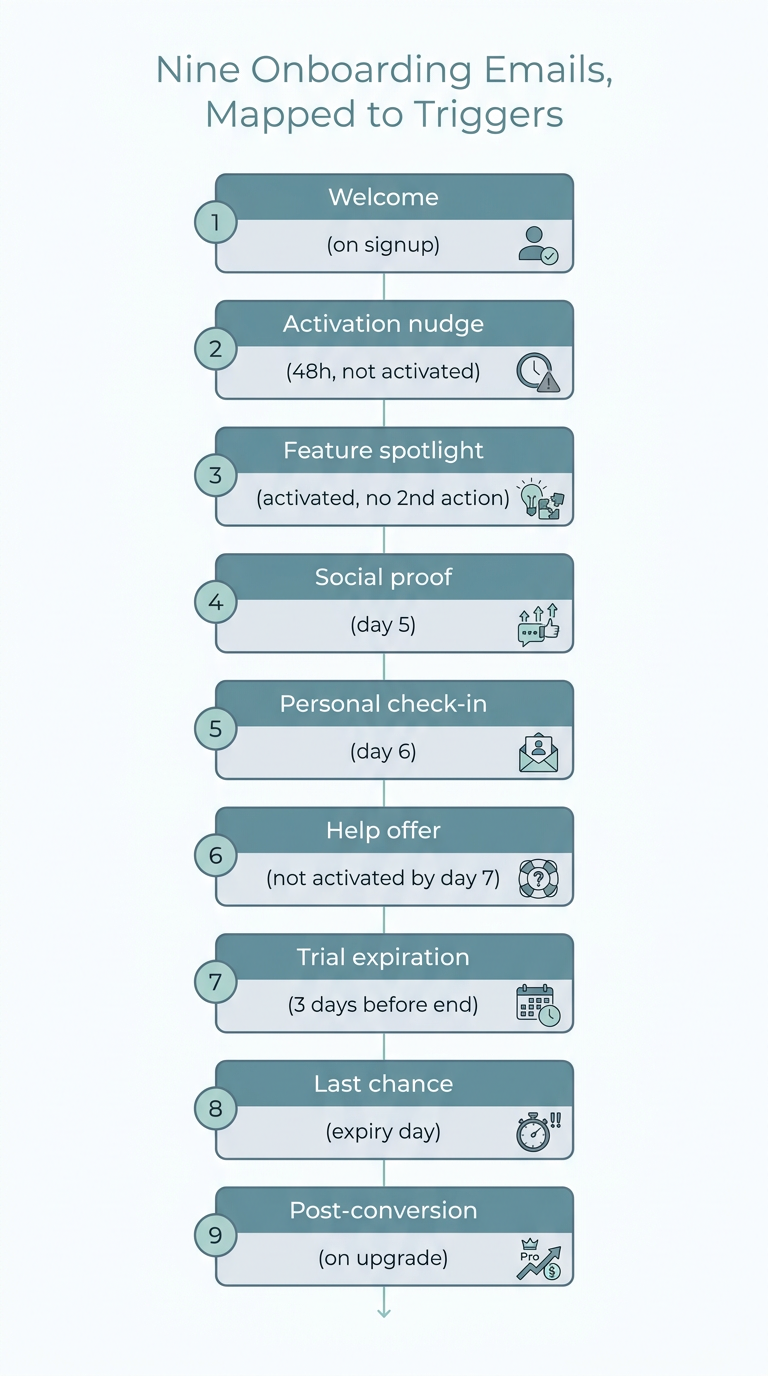
The full set at a glance: each template names the exact product event that should fire it, not a fixed day on the calendar.
The sequence timeline: how the templates fit together
Templates in isolation are just a list. Here is how the nine map onto a standard 14-day SaaS trial, showing the behavioral column beside the old timer-based approach so the difference is obvious.
| Moment | Timer approach (what to avoid) | Behavioral approach (what to build) | Template |
|---|---|---|---|
| Signup | Day 0: welcome | On signup: welcome + first step | 1 |
| ~Day 2 | Day 1: feature tips to everyone | On signup + 48h AND not activated | 2 |
| ~Day 4 | Day 3: another tip | On activated but no second action in 4 days | 3 |
| ~Day 5 | Day 5: case study to everyone | Day 5, activated segment only | 4 |
| ~Day 6 | Day 6: check-in | Day 6, plain-text human check-in | 5 |
| ~Day 7 | Day 7: more tips | Not activated by day 7: help offer | 6 |
| ~Day 11 | Day 11: upgrade push to everyone | 3 days before expiry, activated only | 7 |
| ~Day 14 | Day 14: last chance to everyone | Expiry day, activated non-upgraders | 8 |
| On upgrade | (nothing) | On plan_upgraded: welcome to paid | 9 |
The behavioral column reacts to reality. An activated user might receive four of these emails; a stuck user a different four; a fast converter only two before jumping to template 9. Nobody gets an email that no longer fits their state, because every send checks the user's behavior first.
How many emails should an onboarding sequence have?
The honest answer is: as many as it takes to guide a user to activation, and no more. The count follows two things, not a round number:
- Your trial length. A 7-day trial has less room, so four to five emails is plenty. A 14-day trial supports five to eight. A freemium product with no trial deadline leans more on activation-and-adoption triggers than on countdown emails.
- Your activation milestones. Each distinct milestone (signed up, activated, adopted a second feature, hit a limit) is a natural trigger point for one email. Map the milestones first, then you will have your email count.
Because a behavioral sequence branches, "how many emails" is really "how many emails for this user's path." That is a feature, not a vagueness: the user who succeeds fast is spared the nudges, and the user who stalls gets more help. If you are sending the identical count to everyone, you are running a timer, not a sequence.
Keep your onboarding templates out of spam
You can write the nine best onboarding templates in your market, and if they land in spam, none of it happened. Onboarding email is lifecycle mail, not transactional, so it does not inherit the near-automatic inbox placement a password reset gets. It has to earn the inbox. Three things decide it:
- Authenticate your domain. SPF, DKIM, and DMARC are the baseline. A minimal SPF record for a domain sending through Amazon SES is
v=spf1 include:amazonses.com ~all; DKIM is a signing key you publish as a CNAME; DMARC is a policy record at_dmarc.yourdomain.com. Without these, mailbox providers treat your onboarding mail with suspicion. The SPF, DKIM, and DMARC guide walks through each record. - Separate lifecycle mail from transactional mail. Send onboarding emails from a marketing subdomain, not the same identity as your password resets, so a rough patch on one stream cannot sink the other.
- Let the behavioral targeting protect you. Because each template only reaches users whose state fits it, your complaint and unsubscribe rates stay low, and low complaints are exactly what keeps you in the inbox. Good targeting is good deliverability.
The email deliverability guide covers reputation and inbox placement in full. Treat it as required reading before you scale any onboarding program.
How to measure whether the templates are working
Skip open rate as your headline metric. Apple Mail Privacy Protection and corporate scanners like Mimecast and Proofpoint fire opens automatically, so a raw open rate overstates real human engagement. Judge onboarding on outcomes:
- Activation rate: the share of new signups who reach your activation event, compared before and after the sequence went live. This is the north star.
- Time to activation: days from signup to the aha action. A good sequence shortens it.
- Trial-to-paid rate among the activated: the templates 7 through 9 only earn their place if they convert users who actually saw value.
Use a tool that separates human opens from scanner opens if you want the open rate to mean anything at all. Otherwise you will be tuning subject lines against bots.
Where Meisa fits
Full disclosure: I build Meisa, so this is the one spot I am pitching it. I built it because my own SaaS team was hardcoding onboarding emails and filing an engineering ticket every time we wanted to add a step or change a subject line.
Every template above depends on a trigger, and that is precisely what Meisa is built for. You build the sequence in a visual builder with entry triggers on signup, tag, custom event, form submit, or segment entry, then add delay, condition, split, and goal steps, so the "send unless already activated, then exit on activation" logic in the timeline table is a few clicks, not an engineering ticket. It fires on the custom product events your app already emits, gives you block-based templates with spintax so you are not sending identical copy to your whole list, sends on your own AWS SES so you own your sender reputation, and reports a true open rate that separates human opens from scanner opens. You can even build and adjust the whole sequence from Claude or ChatGPT through its MCP connector.
The honest concession: if you only need a couple of purely time-based welcome emails and never branch on behavior, a simpler tool or your transactional provider's basic automation may be enough. Meisa earns its place when your onboarding depends on what users actually do. For the strategy behind these templates, see the onboarding email guide and how to structure multi-step flows in email sequences for SaaS. To see where onboarding sits in the whole journey, start with lifecycle email for SaaS, and for the wider channel picture, SaaS email marketing.
FAQ
How do I write an onboarding email?
Give each email one job, one call to action, and a subject line that names the user's actual state ("your dashboard is empty" beats "getting started tips"). Lead with the outcome the user gets, not the feature, sign from a real person, and keep the design light so it renders and delivers well. Most importantly, tie the email to a behavior: send it because the user did or did not do something, not because a day passed. That is what makes the subject line specific and the timing right.
What is an example of an onboarding message?
The simplest strong example is the welcome email: "Hi [First name], thanks for signing up for [Product]. The fastest way to see what it does is to [single first action]. It takes about two minutes. [Button] If you get stuck, just reply, a real person reads it." One line of welcome, one clear next step, and a human sign-off. Every other onboarding email follows the same shape: name where the user is, point at the single next action, make it easy.
How many emails should an onboarding sequence have?
Match the count to your trial length and your activation milestones rather than picking a round number. A 7-day trial usually justifies four to five emails; a 14-day trial supports five to eight; a freemium product leans on behavioral triggers instead of a countdown. Because a behavioral sequence branches, the real answer is per-user: someone who activates fast might get two emails while a stuck user gets five. Map your milestones first and the email count follows.
Should onboarding emails be time-based or behavior-based?
Behavior-based, with time as a fallback. A pure timer sends the same "day 3" email to a user who already succeeded and to one who is completely stuck, wasting both. The stronger pattern is trigger plus condition: send an email a set time after an event only if the relevant action has not happened yet, and exit the sequence the moment the user activates. Use the timer only for the wait between checks, never as the trigger itself.
Is an onboarding email the same as a welcome email?
No. A welcome email is usually the first email in an onboarding sequence, but onboarding is the whole sequence, not one send. The welcome email greets the user and points at their first step; the later emails react to what they do next, nudging stuck users, celebrating activation, and converting the trial. If the welcome email also carries an account verification link, that first send is transactional; the educational emails that follow are lifecycle onboarding.
Why do my onboarding emails go to spam?
The two usual causes are missing domain authentication and a mixed sending reputation. Publish SPF, DKIM, and DMARC so mailbox providers trust your domain, and send onboarding email from a marketing subdomain separate from your transactional stream so a marketing complaint cannot drag down your whole reputation. Behavioral targeting helps too: emailing users only the message that fits their state keeps complaint and unsubscribe rates low, which is what keeps you in the inbox.