When a bot opens your email first, the real reader still shows up 23.3% of the time
Security scanners and pre-fetchers open email the moment it lands. We followed 25,084 opened emails to see what happens next: how many were only ever opened by machines, and how many were read by a person later.
- Published 22 October 2026
- 25,084 opened emails
- Selected sample
- 3 March to 14 October 2026
- People only
- Bot first, then a person
- Bots only
All opened emails: People only 61.2%, Bot first, then a person 9.1%, Bots only 29.8%
At a glance
The numbers worth quoting
Key findings
What the data says
- 129.8% bot-only
Nearly three in ten emails that a dashboard calls opened were opened by machines alone, with no later human open.
- 2Bots are instant
95% of opens from known scanner signatures came within 5 seconds of delivery, and 97.5% within the first minute.
- 3People take their time
Only 1.8% of human opens came in the first 5 seconds. 60% came more than 30 minutes after delivery.
- 4Readers come back hours later
Of the emails where a person opened after a bot, 56% of those opens came more than two hours later, and 17% more than a day later.
- 5Win-back gets scanned hardest
25% of win-back open events came from security scanners, more than twice the share of any other marketing email.
- 6Sign-in emails are left alone
Fewer than 1 in 500 opened sign-in and verification emails were flagged as bot opens, because Meisa judges those on scanner signatures only.
How Meisa tells bots from people
Each open is judged on its own
- Delivered
- 2 sec BOT
Open + every link clicked
- 40 sec BOT
Another instant open
- 30 minutes
- 3 hours HUMAN
The reader opens it, counted as a human open even though bots opened it first
| Signal | What counts | Verdict |
|---|---|---|
| Known scanner | The open or click comes from a known security-scanner signature | Bot, always |
| Instant open | An open in the first 2 minutes after delivery | Bot |
| Link sweep | 80% or more of the email's links (at least 2) clicked within 3 minutes | Bot |
| Everything else | Any other open or click. After 30 minutes it counts as the person even if a bot opened first | Person |
| Sign-in and trigger emails | Timing rules are switched off, because people open these at once | Signature only |
Apple Mail Privacy Protection is a different problem: its opens look slow and human. The True Open Rate Report measures it separately.
Timing
How long after the bot did the person open?
Speed tells
When each kind of open lands
| Source | Under 5 s | 5 to 60 s | 1 to 30 min | 30 min to 6 h | 6 to 24 h | Over a day |
|---|---|---|---|---|---|---|
| Security scanners | 95.3% | 2.2% | 0.5% | 0.9% | 0.5% | 0.6% |
| Instant pre-fetch | 33.2% | 66.8% | 0.0% | 0.0% | 0.0% | 0.0% |
| People | 1.8% | 15.1% | 23.1% | 26.5% | 15.4% | 18.1% |
| Apple Mail proxy | 0.1% | 0.7% | 13.4% | 25.5% | 24.7% | 35.6% |
By email type
Who opens each kind of email
- People
- Apple Mail proxy
- Security scanners
- Instant pre-fetch
Sign-in and verification: People 74.3%, Apple Mail proxy 21.2%, Security scanners 4.5%, Instant pre-fetch 0.0%
Behavioral triggers: People 48.4%, Apple Mail proxy 31.6%, Security scanners 10.1%, Instant pre-fetch 9.9%
Product notifications: People 43.7%, Apple Mail proxy 42.3%, Security scanners 6.1%, Instant pre-fetch 7.9%
Onboarding sequences: People 42.1%, Apple Mail proxy 43.9%, Security scanners 8.6%, Instant pre-fetch 5.4%
Win-back and recovery: People 35.7%, Apple Mail proxy 34.2%, Security scanners 25.0%, Instant pre-fetch 5.1%
Broadcasts and newsletters: People 34.1%, Apple Mail proxy 47.3%, Security scanners 10.4%, Instant pre-fetch 8.2%
| Email type | Opened emails | Bot-touched | Later read by a person | Bot-only |
|---|---|---|---|---|
| Product notifications | 5,823 | 31.8% | 39.9% | 19.1% |
| Broadcasts and newsletters | 5,396 | 38.7% | 31.7% | 26.4% |
| Onboarding sequences | 4,377 | 14.8% | 32% | 10.1% |
| Win-back and recovery | 1,481 | 32.2% | 25.6% | 24% |
Clicks
Bots click too, so read clicks as a range
Link scanners follow links to check them before the recipient does. With scanner signatures and a 10-second rule, the click rate barely moves: 3.23% raw against 3.13% human. Meisa's live rules are stricter: they also treat clicks in the first two minutes and link sweeps as automated, and by that reading 51.8% of emails with a click had only bot clicks.
The honest answer sits between the two. Many fast clicks come from ordinary browsers on ordinary phones, which is what a careful scanner wants to look like, and also what a keen reader looks like. If you branch automations on clicks, the stricter reading is the safer one.
What to do with this
Three habits that keep your numbers honest
Never drop a contact for one bot hit
12.9% of your real readers arrive after a bot. Suppressing or tagging contacts on the first open throws them away.
Wait before you judge a send
The median reader shows up 3.1 hours after the bot. Compare subject lines and resend to non-openers only after a day.
Spread big sends out
Bursts are what spam filters notice. Meisa's Warm Send paces a broadcast in waves over up to 24 hours, most engaged readers first, and per-recipient wording variations (spintax) got 1.4x the human opens in our spintax study.
Methodology
How we measured it
Data. The same 71,602 delivered emails as the True Open Rate Report, 3 March to 14 October 2026, selected from software products that send through Meisa.
Bot-touched, rescued and bot-only. We re-ran Meisa's production scoring rules over every open and click. An email is bot-touched if at least one open scored as a bot, rescued if it also had a human-scored open, and bot-only if every open scored as a bot. The gap is the time from the first bot open to the first human open.
Open sources. The source mix and timing tables use the study classification described in the research methodology: scanner signatures, Apple's proxy user agent, other opens within 10 seconds, and everything else as people.
Anonymization. Aggregates only. Every group shown has at least 300 delivered emails, and no sender can be identified.
FAQ
Common questions
How can you tell a bot email open from a human one?
By speed, by behaviour and by signature. Opens in the first seconds after delivery are faster than people react. Clicking nearly every link at once is a scanner testing them. Known scanner user agents give themselves away. A later open with none of those signs is treated as the person.
If a bot opens my email first, can the person still open it?
Yes, and it happens often. 23.3% of the emails a bot opened were opened by the recipient later, a median of 3.1 hours after the bot hit.
Why not ignore every email a bot touched?
Because you would lose real readers. 12.9% of all emails a person opened had a bot open first. Judging each open on its own keeps those readers in the count.
Do bots click links too?
Yes. Link scanners follow links to check them, often all of them within seconds. That is why an email where every link was clicked straight after delivery is treated as a sweep, not a reader.
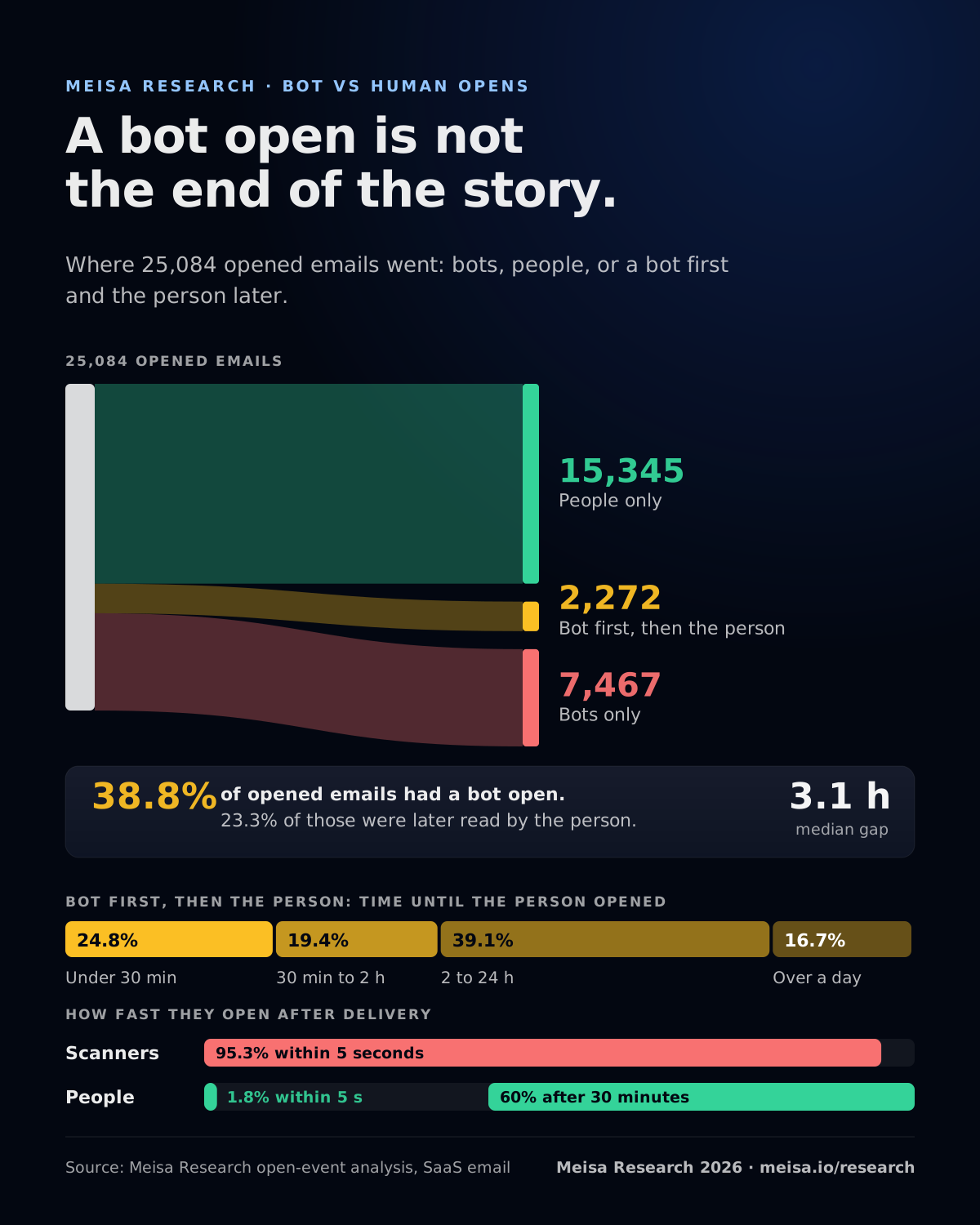
Bot opens versus human opens
Free to share in a post, deck or article with a link back to this page.
Download the infographic (SVG)Cite this research
Quote it, chart it, link it
Meisa (2026). Bots vs humans: how email opens get judged. Meisa Research. https://meisa.io/research/bot-vs-human-opens
<a href="https://meisa.io/research/bot-vs-human-opens">Bots vs humans: how email opens get judged</a> (Meisa Research, 2026)
In 71,602 delivered SaaS emails (Meisa Research, 2026), 38.8% of opened emails had at least one bot open. 23.3% of those bot-opened emails were later opened by the real recipient, a median of 3.1 hours after the bot.
Free to quote, chart and republish with a link back to this page (CC BY 4.0).
Count the reader, not the scanner
Meisa scores every open and click on each send, so a bot hit never hides the person who opens later.