Spread-out onboarding got 1.75x the clicks per email
We compared onboarding sequences that send every email within 3.5 days of signup with sequences of 2 to 3 emails spread over 6 to 10 days. Opens were the same. Clicks and unsubscribes were not.
- Published 22 October 2026
- 9,695 delivered emails
- 3,189 new users
- Bot-filtered
At a glance
The numbers worth quoting
Key findings
What the data says
- 1Same opens
Both shapes got exactly 18.9% human opens per email. Packing emails together did not make people read more of them.
- 21.75x the clicks per email
Spread-out emails were clicked 7.15% of the time, against 4.08% for emails in a dense sequence.
- 3Half the unsubscribes
0.76% unsubscribed per spread-out email, against 1.49% per email in a dense sequence.
- 4Dense sequences reach more people
More emails means more chances: 37.9% of contacts in a dense sequence opened at least one email, against 32.4%.
- 5Spread-out sequences convert more people
12% of contacts in a spread-out sequence clicked at least once, against 8.9% in a dense one.
Full table
Every figure in one place
| Sequence | Delivered | Human open | Human click | Unsubscribe | Users who opened one | Users who clicked one |
|---|---|---|---|---|---|---|
| Spread out: 2 to 3 emails over 6 to 10 days | 657 | 18.9% | 7.15% | 0.76% | 32.4% | 12.0% |
| Short and dense: every email within 3.5 days | 9,038 | 18.9% | 4.08% | 1.49% | 37.9% | 8.9% |
What to do with this
How to shape an onboarding sequence
Send the first email on day one
The first 24 hours after signup are still the best moment for the welcome email. Spacing is about what follows it.
Then give each email room
Two or three follow-ups over a week or more each get more clicks and fewer unsubscribes than a burst in the first three days.
Let behavior fill the gaps
Instead of more scheduled emails, trigger one when a user does or skips a key step. Meisa sequences and triggers run side by side.
Methodology
How we measured it
Sample. We selected 9,695 delivered onboarding emails to 3,189 new users: 9,038 in dense sequences and 657 in spread-out ones. Selection criteria: onboarding sequence emails whose whole sequence fits one of the two shapes below. We refresh the figures every quarter.
Sequence shape. Each new user's onboarding emails are grouped by how long the whole sequence took. Dense: every email within 3.5 days of the first. Spread out: 2 to 3 emails over 6 to 10 days. Other shapes are left out of this comparison.
Opens and clicks. The same bot filtering as the True Open Rate Report. Unsubscribes are counted against the last email the contact received in the seven days before.
Privacy. Aggregates only, with no sender names, recipient addresses or email content. See the full research methodology.
FAQ
Common questions
Should onboarding emails be packed into the first few days?
Not if you judge each email on clicks. Sequences spread over 6 to 10 days got 7.15% clicks per email, against 4.08% for sequences packed into 3.5 days. Open rates were identical at 18.9%.
Do short onboarding sequences reach more users?
Yes. Dense sequences send more emails, so more people open at least one: 37.9% of contacts opened at least one email, against 32.4% for spread-out sequences. But more of the spread-out contacts clicked at least once, 12% against 8.9%.
Do more onboarding emails cause more unsubscribes?
In this data, yes. Dense sequences had 1.49% unsubscribes per email, twice the 0.76% of spread-out sequences.
Does this contradict the first-24-hours finding?
No. The first day after signup is still the best time for the first email. This page is about what comes after it: a few well-spaced follow-ups beat a burst of emails in the first three days.
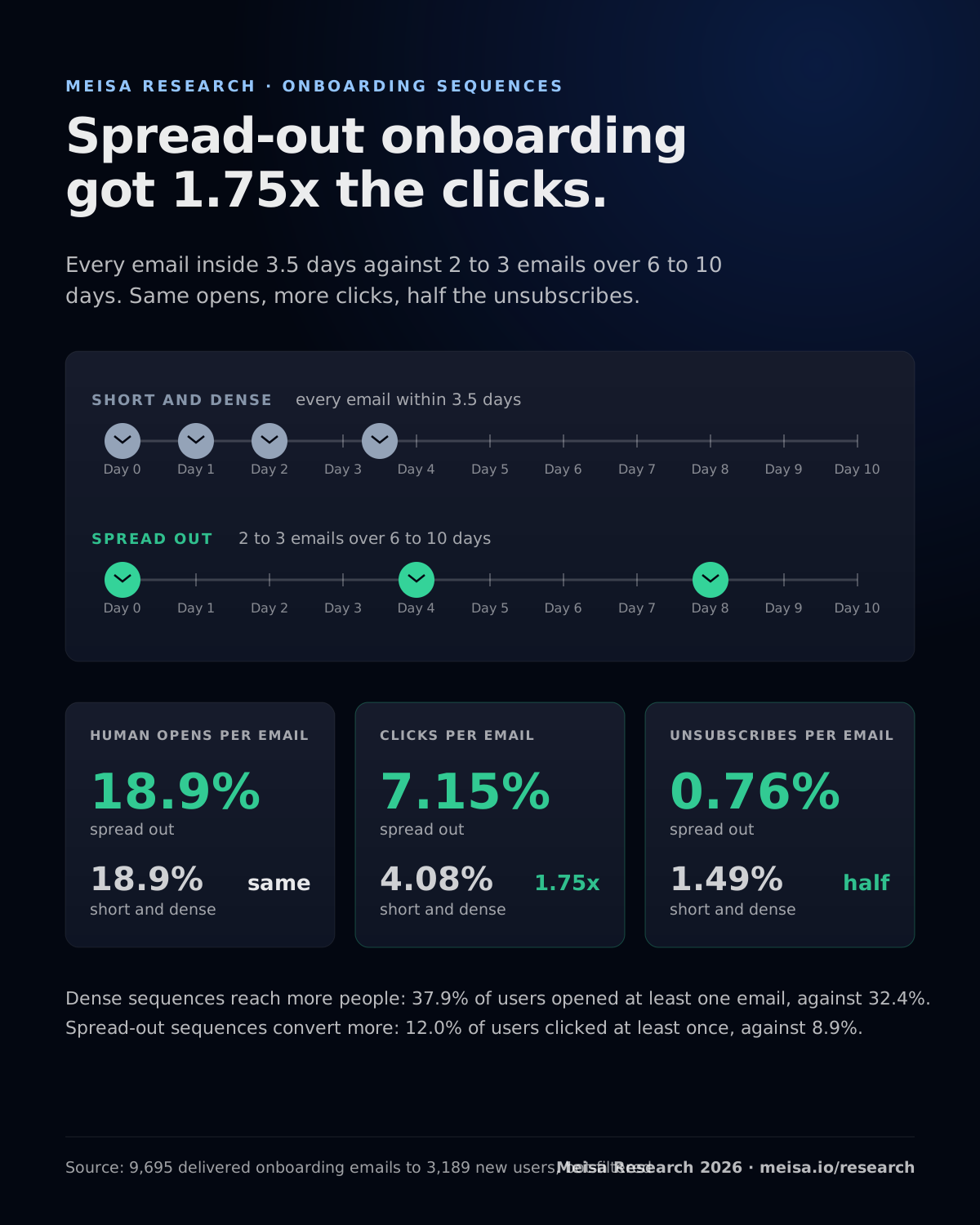
Short and dense versus spread-out onboarding
Free to share in a post, deck or article with a link back to this page.
Download the infographic (SVG)Cite this research
Quote it, chart it, link it
Meisa (2026). Short vs spread-out onboarding sequences. Meisa Research. https://meisa.io/research/onboarding-sequence-length
<a href="https://meisa.io/research/onboarding-sequence-length">Short vs spread-out onboarding sequences</a> (Meisa Research, 2026)
Onboarding sequences of 2 to 3 emails spread over 6 to 10 days had a 7.15% human click rate per email and 0.76% unsubscribes, against 4.08% and 1.49% for sequences with every email inside 3.5 days. Human open rates were the same, 18.9% (Meisa Research, 2026, 9,695 delivered emails).
Free to quote, chart and republish with a link back to this page (CC BY 4.0).
Space your onboarding emails
Meisa lets you set the delay between every onboarding email and shows the human click rate of each step, so you can see where the sequence works.