The first wave of a paced broadcast got 2.1x the human opens
We followed 9,032 broadcast emails that went out in waves, most engaged contacts first. The first wave gets most of the opens and clicks, so it is the early signal worth watching.
- Published 22 October 2026
- 9,032 delivered emails
- Selected sample
- Bot-filtered
- Raw open rate
- Human open rate
At a glance
The numbers worth quoting
Key findings
What the data says
- 12.1x the opens in wave one
18.2% of first-wave emails were opened by a person, against 8.8% across the waves that followed.
- 26.4x the clicks
The first wave clicked at 5.93%. Later waves clicked at 0.92%, and the last wave at 0.55%.
- 3Raw opens exaggerate the gap
The first wave's raw open rate was 52.5%, almost three times later waves. Engaged readers often use Apple Mail, whose proxy adds machine opens on top of the real ones.
- 4Unsubscribes fall wave by wave
1.49% in wave one, 1.02% in wave two and 0.41% in wave three. Paced broadcasts overall had 0.94% unsubscribes, against 1.66% for the same senders' one-shot sends.
- 5Not a lift on its own
Across all waves, paced broadcasts got 11.9% human opens, against 13.5% for one-shot broadcasts from the same senders. Pacing changes who sees the email first, not how good the email is.
Full table
Every wave in one place
| Group | Delivered | Raw open | Human open | Human click | Unsubscribe |
|---|---|---|---|---|---|
| Wave 1: most engaged contacts | 2,949 | 52.5% | 18.2% | 5.93% | 1.49% |
| Wave 2: next most engaged | 2,656 | 18.3% | 8.5% | 1.39% | 1.02% |
| Wave 3: least engaged | 3,427 | 18.1% | 9.0% | 0.55% | 0.41% |
| All waves | 9,032 | 29.4% | 11.9% | 2.56% | 0.94% |
| One-shot broadcasts, same senders | 10,919 | 31.8% | 13.5% | 3.42% | 1.66% |
What to do with this
How to use a paced send
Read wave one as your forecast
The first wave reaches your best readers. If it opens and clicks well, the email works. If it does not, later waves will do worse, so you can stop and fix it.
Put your best readers first
Order by real human opens and clicks, not raw opens. Raw opens rank Apple Mail users at the top whether they read or not.
Pace big sends for safety
Spreading a large broadcast over hours keeps sudden volume and complaint spikes away from your sending reputation. Meisa's Warm Send does the ordering and pacing for you.
Methodology
How we measured it
Sample. We selected 9,032 delivered emails from paced broadcasts and 10,919 delivered one-shot broadcast emails from the same senders. Selection criteria: broadcasts sent with Warm Send, compared with ordinary broadcasts from senders who used it. We refresh the figures every quarter.
Waves. Meisa's Warm Send ranks contacts by past human opens and clicks, then sends the broadcast in waves, best readers first, over up to 24 hours. Each email is assigned to the wave it went out in.
Opens and clicks. The same bot filtering as the True Open Rate Report. Unsubscribes are counted against the last email the contact received in the seven days before.
Privacy. Aggregates only, with no sender names, recipient addresses or email content. See the full research methodology.
FAQ
Common questions
What is a phased or warm send?
Instead of sending a broadcast to the whole list at once, it goes out in waves over several hours. The first wave goes to the contacts who opened and clicked most in the past, and later waves follow once the first has landed.
Does the first wave really perform better?
Yes, by a wide margin. The first wave got 18.2% human opens and 5.93% clicks. Waves two and three together got 8.8% and 0.92%. That is 2.1x the opens and 6.4x the clicks.
Do paced broadcasts beat sending to everyone at once?
Not on overall opens in this data. Paced broadcasts averaged 11.9% human opens, against 13.5% for the same senders' one-shot broadcasts. They did have fewer unsubscribes, 0.94% against 1.66%. Pacing protects reputation and shows you early results; it does not make a weak email stronger.
Why do later waves unsubscribe less?
Less engaged contacts mostly ignore the email rather than act on it. Unsubscribes fell from 1.49% in the first wave to 0.41% in the last. Readers who care enough to open are also the ones who decide to leave.
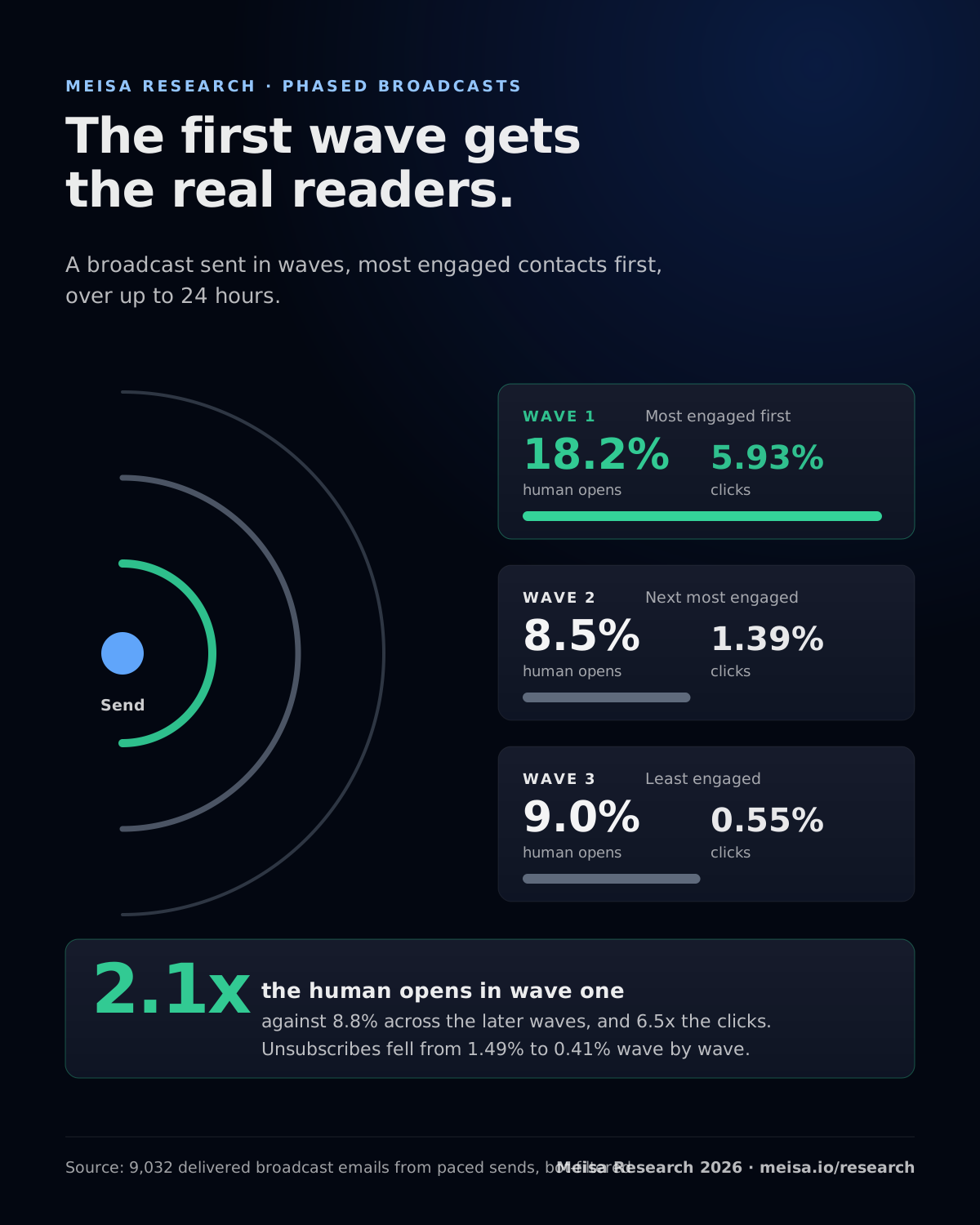
A paced broadcast, wave by wave
Free to share in a post, deck or article with a link back to this page.
Download the infographic (SVG)Cite this research
Quote it, chart it, link it
Meisa (2026). Phased broadcasts, wave by wave. Meisa Research. https://meisa.io/research/warm-send-phased-broadcasts
<a href="https://meisa.io/research/warm-send-phased-broadcasts">Phased broadcasts, wave by wave</a> (Meisa Research, 2026)
When a broadcast was sent in waves with the most engaged contacts first, the first wave had an 18.2% human open rate and a 5.93% click rate, against 8.8% and 0.92% for later waves (Meisa Research, 2026, 9,032 delivered emails).
Free to quote, chart and republish with a link back to this page (CC BY 4.0).
Send to your best readers first
Meisa's Warm Send ranks your list by real human engagement and paces big broadcasts in waves, so you see how an email lands before everyone gets it.