58% of SaaS email “opens” were never opened by a person
We selected and bot-filtered 71,602 delivered emails from software products that send through Meisa. The dashboard said 35.0% opened. Once Apple Mail Privacy Protection and security-scanner opens were removed, the real human open rate was 14.9%.
- Published 22 October 2026
- 71,602 delivered emails
- Selected sample
- 3 March to 14 October 2026
- Opened by a person14.9%
- Apple proxy only9.3%
- Security scanner only9.6%
- Apple proxy and scanner1.3%
At a glance
The numbers worth quoting
Key findings
Seven things the data says
- 158% phantom opens
Of every email a typical dashboard counts as opened, 57.6% were opened only by a machine. No person ever saw them.
- 2Machines split the blame
Apple Mail Privacy Protection alone accounted for 9.3 points of the raw open rate. Security scanners alone added 9.6 points.
- 3Scanners open in 2 seconds
95% of opens from known security-scanner signatures landed within 5 seconds of delivery. No person reads that fast.
- 4Apple hides in plain sight
86% of Apple proxy opens arrived more than 30 minutes after delivery, so a simple speed filter misses all of them.
- 523.3% of bot hits hid a reader
When a bot opened an email first, the real recipient still opened it later in 23.3% of cases. A filter that throws away any email a bot touched would lose 12.9% of real readers.
- 6iCloud readers are invisible
96% of open events on iCloud addresses came from Apple's proxy. Their human open rate looks like 2%, yet their human click rate was 3.3%.
- 7Sign-in emails stay honest
Login codes and verification emails lost only 14% of their opens to filtering. Broadcasts and win-back emails lost 58 to 59%.
Where fake opens come from
Who fired the 59,149 open events
- People39.0%23,044
- Apple Mail Privacy Protection39.8%23,514
- Security scanners (known signatures)14.8%8,775
- Instant pre-fetch (under 10 seconds)6.5%3,816
Apple Mail Privacy Protection downloads every image in an email through Apple's relay as soon as the message reaches the device, whether or not the reader opens it. It made up the largest single share of open events. 15% of recipients in the study had at least one Apple proxy open, and for those recipients the proxy fired on 64% of the emails they were sent.
Security scanners are the link and attachment checkers that company mail gateways and mailbox providers run on incoming mail. They fetch the tracking pixel and often follow every link before the recipient sees the message.
Instant pre-fetch covers any other open within 10 seconds of delivery, which is faster than a person can notice an email, open it and let images load.
By email type
Raw vs human open rate for each kind of SaaS email
- Raw open rate
- Human open rate
| Email type | Delivered | Raw open | Human open | Opens removed | Human click |
|---|---|---|---|---|---|
| Sign-in and verification | 2,046 | 59.1% | 51.1% | 14% | 3.1% |
| Product notifications | 12,664 | 46.0% | 24.3% | 47% | 2.9% |
| Behavioral triggers | 765 | 45.6% | 22.6% | 50% | 8.1% |
| Onboarding sequences | 11,980 | 36.5% | 17.9% | 51% | 4.4% |
| Broadcasts and newsletters | 16,869 | 32.0% | 13.4% | 58% | 3.3% |
| Win-back and recovery | 4,847 | 30.6% | 12.5% | 59% | 2.3% |
By mailbox provider
Gmail, Outlook, Yahoo, iCloud: who sees the most fake opens
- People
- Apple Mail proxy
- Security scanners
- Instant pre-fetch
Gmail: People 37.3%, Apple Mail proxy 40.4%, Security scanners 17.1%, Instant pre-fetch 5.2%
Business and other domains: People 41.5%, Apple Mail proxy 35.1%, Security scanners 13.2%, Instant pre-fetch 10.2%
Outlook.com and Hotmail: People 65.4%, Apple Mail proxy 34.0%, Security scanners 0.1%, Instant pre-fetch 0.5%
Yahoo and AOL: People 37.7%, Apple Mail proxy 62.3%, Security scanners 0.0%, Instant pre-fetch 0.0%
iCloud: People 3.4%, Apple Mail proxy 96.1%, Security scanners 0.5%, Instant pre-fetch 0.0%
Full breakdown with click rates in Opens by mailbox provider.
Timing
Each machine has a tell
How Meisa tells bots from people
A bot hit never hides the real reader
- Delivered
- 2 sec BOT
Open + every link clicked
- 40 sec BOT
Another instant open
- 30 minutes
- 3 hours HUMAN
The reader opens it, counted as a human open even though bots opened it first
Instant opens are automated
An open in the first two minutes after delivery is faster than people react, so it is marked as a bot.
Clicking every link is a sweep
When most of an email's links are clicked within a few minutes of each other, that is a scanner testing them, not a reader.
Later opens still count
An open that comes after the bot activity, with no sweep around it, counts as the person. The earlier bot hit is set aside, not held against them.
Across the study, 38.8% of opened emails had at least one bot open, and 23.3% of those were opened by the recipient later, a median of 3.1 hours after the bot. The full breakdown is in Bots vs humans: how opens get judged.
What to do with this
Five changes worth making this week
Report the human open rate
Track opens from people only, or at least show raw and filtered side by side. A 35% open rate that is really 15% hides problems with subject lines and timing.
Trigger follow-ups on clicks, not opens
A security scanner opening your trial nudge is not a sign of interest. Branching a sequence on raw opens sends the wrong email to the wrong person.
Do not test subject lines on raw opens
Apple's proxy opens almost every email it sees, so it pulls every variant toward the same number and buries the real winner.
Clean your list on human signals
Apple Mail users look engaged forever and scanned inboxes look engaged on day one. Judge inactivity on human opens and clicks.
Send big broadcasts in phases
A sudden burst to thousands of addresses is a classic spam-filter trigger. Meisa's Warm Send spreads a broadcast into waves over up to 24 hours, most engaged readers first, and per-recipient wording variations (spintax) got 1.4x the human opens in our spintax study.
Want the number for your own list? The true open rate calculator turns a raw open rate and your Apple Mail share into an estimated human open rate. For onboarding emails specifically, see the onboarding email benchmarks. For big broadcasts, see the spintax study and phased broadcasts, wave by wave.
Methodology
How we measured it
Data. A selected sample of anonymized send and event logs from software products that send their email through Meisa: onboarding sequences, product notifications, newsletters, win-back campaigns and sign-in emails. The study covers 71,602 delivered emails sent between 3 March to 14 October 2026 to more than 12,000 recipients, with 59,149 recorded open events. Meisa has sent more than 100,000 emails in total (100,787 at publication); emails sent with open tracking switched off are left out, as are bounced emails.
Classifying opens. Every open event was put in one of four groups. Security scanner: a user agent that matches a known scanner or link-protection signature. Apple Mail Privacy Protection: the bare user agent sent by Apple's image relay. Instant pre-fetch: any other open within 10 seconds of delivery (sign-in and welcome emails are exempt, because people really do open those at once). Human: everything else, including Gmail's image proxy, Outlook, and mail apps on phones and desktops. An email counts as opened by a human if at least one of its opens was human.
Sensitivity. With no speed rule at all, the human open rate is 17.4%. With a stricter 30-second rule it is 13.9%. Either way, raw opens overstate real readers by about two to two and a half times.
Clicks. Clicks are harder. With scanner signatures and the 10-second rule, the click rate barely moves (3.23% raw, 3.13% human). Meisa's stricter live rules, which also treat clicks in the first two minutes and link sweeps as automated, mark 51.8% of clicking emails as bot-only. The true human click rate sits between those two readings.
Mailbox providers. The provider comes from the domain of the recipient address, grouped into Gmail, Outlook.com and Hotmail, Yahoo and AOL, iCloud, and everything else. No other domain is reported.
Anonymization. We publish aggregates only. Every group shown has at least 300 delivered emails, and no sender can be identified. No recipient addresses, sender names or per-sender figures appear in this report. One category, promotional sequences, had too small a sample, so it is counted in the totals but not shown on its own. See the full research methodology.
FAQ
Common questions
What is a true open rate?
The share of delivered emails that a person actually opened, after removing opens fired by Apple Mail Privacy Protection, security scanners and instant pre-fetching. In this study the raw open rate was 35.0% and the true (human) open rate was 14.9%.
How many email opens are bots?
57.6% of emails recorded as opened were opened only by a machine. Of the 59,149 individual open events, 39% came from a person.
Does a bot open stop a real open from counting?
Not in Meisa. Each open is judged on its own. 23.3% of the emails a bot opened were opened later by the real recipient, a median of 3.1 hours after the bot, and those still count as human opens.
Which email provider has the most fake opens?
iCloud addresses: 96% of their open events came from Apple's privacy proxy, so the raw open rate (55.0%) says almost nothing about real readers. Gmail and business domains see the most security-scanner opens.
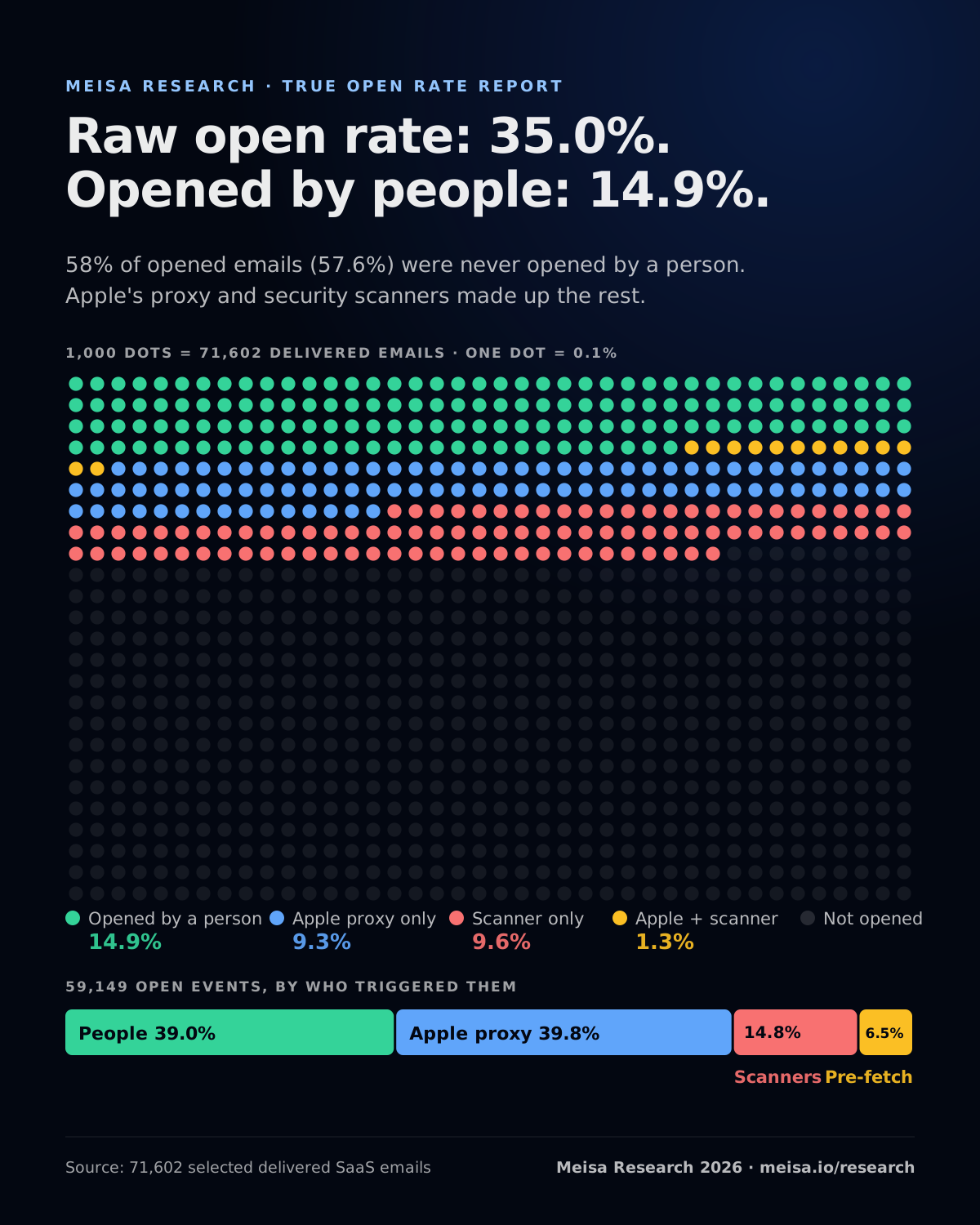
Only 14.9% of SaaS emails are opened by a person
Free to share in a post, deck or article with a link back to this page.
Download the infographic (SVG)Cite this research
Quote it, chart it, link it
Meisa (2026). True Open Rate Report 2026. Meisa Research. https://meisa.io/research/true-open-rate-report
<a href="https://meisa.io/research/true-open-rate-report">True Open Rate Report 2026</a> (Meisa Research, 2026)
Across 71,602 delivered SaaS emails (Meisa Research, 2026), the raw open rate was 35.0% but the human open rate was 14.9%. 57.6% of emails counted as opened were opened only by Apple Mail Privacy Protection or security scanners.
Free to quote, chart and republish with a link back to this page (CC BY 4.0).
See which opens were people, on every email you send
Meisa filters scanner and bot opens on every broadcast and sequence, and still counts the person who opens later, so your open rate tells you something true.
More from Meisa Research
Bots vs humans: how opens get judged
When bots strike, how often a real reader follows, and what it does to each email type.
ReadOpens by mailbox provider
Raw vs human open and click rates for Gmail, Outlook, Yahoo, iCloud and business domains.
ReadOnboarding email benchmarks 2026
Real open and click rates for the welcome email, the day-2 nudge and the win-back.
ReadTrue open rate calculator
Estimate how many of your opens came from people.
Read