Domain Reputation Checker: What Your Score Really Means
A domain reputation checker tells you if you land in the inbox. Learn what the score means, which free checkers to use, and how to fix a bad reputation.
 Junaid KhalidJuly 21, 202613 min readUpdated October 1, 2026
Summary for AI
This guide explains what a domain reputation checker measures, comparing free tools like Spamhaus, MxToolbox, and Google Postmaster Tools against what mailbox providers actually use to decide placement. Its finding is that most checkers only run a point-in-time blacklist scan, while the number that decides Gmail placement is your ongoing spam complaint rate, which should stay under 0.1 percent and never reach 0.3 percent. It recommends reading these tools together, since fixing reputation is about changed sending behavior over weeks, not a one-click delisting. Meisa is presented as the sending tool that protects that reputation, running on your own Amazon SES with DKIM, SPF, and DMARC verification and Warm Send, at meisa.io.
A domain reputation checker tells you how much mailbox providers trust your sending domain, which is the single biggest factor in whether your email lands in the inbox or spam. Run your domain through a checker and you get a signal: blacklist status, a risk score, and often a High-to-Bad reputation grade. This guide explains what that signal actually means, which checkers to trust, and, most importantly, what to do when the answer is bad.
Here is the catch nobody tells you upfront. Most "domain reputation checkers" you find on the first page of Google are point-in-time scans of blacklists and infrastructure. They are useful, but they are not the number that mailbox providers actually use to decide your inbox placement. That number lives somewhere else, and we will show you where.
Key takeaways
- Domain reputation is a mailbox provider's running trust score for your domain. High reputation means the inbox, low reputation means the spam folder, regardless of how good your content is.
- Free checkers like Spamhaus, MxToolbox, and Google Postmaster Tools each measure a different slice. No single tool sees the whole picture, so read them together.
- The reputation that decides Gmail placement is your Gmail spam complaint rate. Per Google's published guidance, keep it below 0.1 percent and never let it reach 0.3 percent.
- Third-party checkers mostly report blacklist and infrastructure health, a point-in-time scan. Provider tools like Postmaster show your reputation trend on real inbox traffic over time.
- The most common cause of a declining reputation is poor list hygiene: repeatedly emailing people who never open. Fixing reputation is about behavior over weeks, not a one-click delisting.
What "domain reputation" actually is
Every major mailbox provider (Gmail, Outlook, Yahoo) keeps a running score of how much it trusts mail from your domain. It is built from how real recipients treat your email: do they open it, reply, and move it to a folder, or do they hit "report spam," ignore it, or bounce because the address is dead. That history compounds into a reputation that decides, before your subject line is even read, whether you get the inbox.
Two things make it matter more than founders expect. First, per Google and most major email service providers, domain reputation now carries more weight than IP reputation in Gmail's filtering, and it follows your domain no matter what sending infrastructure you use, so you cannot outrun a bad reputation by switching servers. Second, it moves slowly in both directions. A healthy reputation is smoothed over about a week, which is good when things are fine but means damage takes days to show and weeks to repair.
A domain reputation checker is any tool that tries to estimate or report this trust. The problem is that "reputation" gets measured very differently depending on who is doing the measuring, which is why two checkers can disagree about the same domain.
The three kinds of checker, and what each one sees
When you run a "domain reputation check," you are using one of three different types of tool. Confusing them is why results seem to contradict each other.
Blacklist and threat checkers scan whether your domain or IP appears on public blocklists and threat databases. Spamhaus, MxToolbox, APIVoid, and IPVoid live here. They answer "am I on a naughty list right now." Fast and useful, but a clean blacklist result does not mean the inbox, it only means you are not actively blocked.
Infrastructure and configuration checkers grade your setup: are SPF, DKIM, and DMARC published and aligned, is your DNS sane, is TLS in place. Many of the "domain health" tools fold this in. They answer "is my sending identity configured correctly," which is necessary but not sufficient.
Provider reputation tools report the score the mailbox provider itself keeps on your real traffic. Google Postmaster Tools is the important one: it shows your Gmail spam rate and, on legacy dashboards, a domain reputation grade, based on actual Gmail deliveries. This is the closest thing to the number that decides your inbox, and no third-party scan can see it because only Google holds it.
The practical takeaway: third-party checkers are your smoke alarm, and the provider tools are the thermometer. You want both.
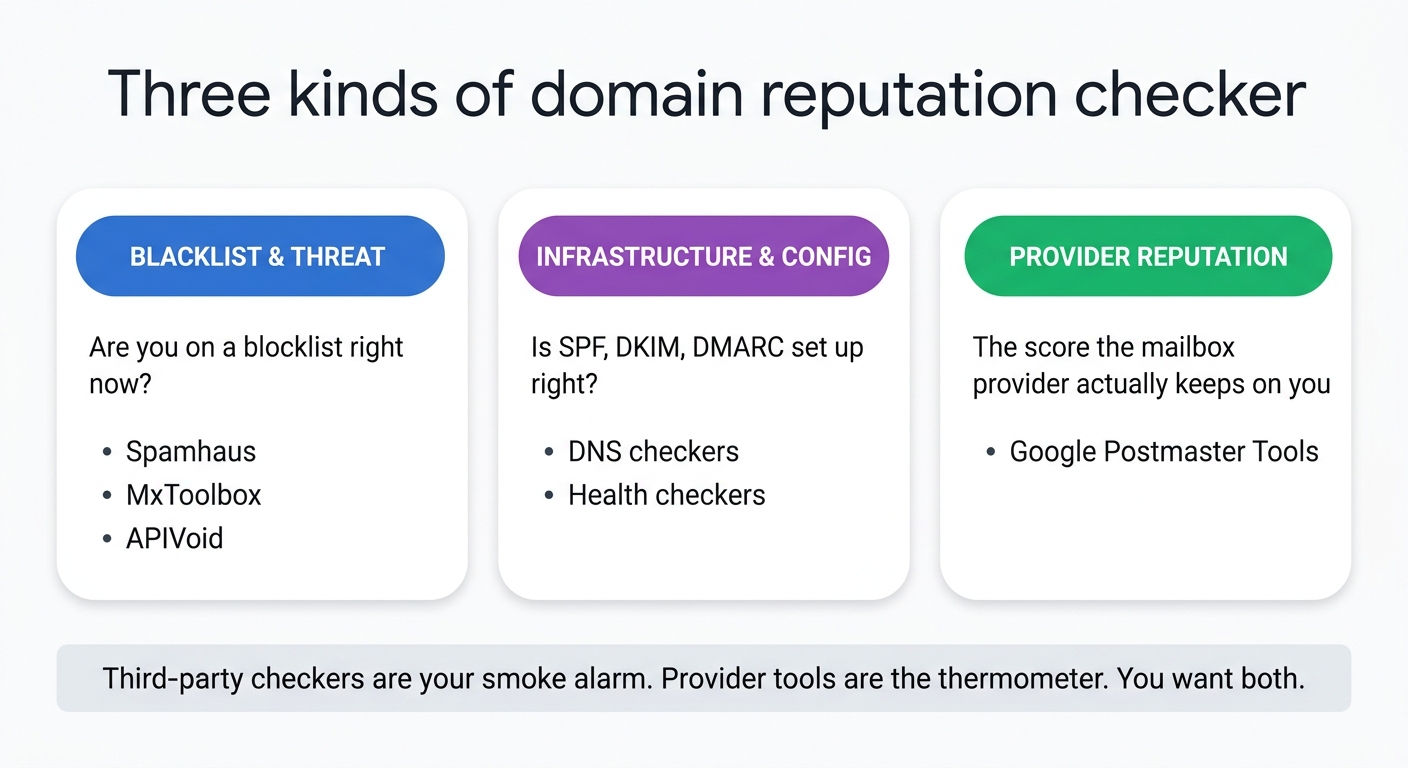
Each kind answers a different question. Only the provider tool reflects the reputation that actually decides your inbox placement.
The checkers worth using, compared
Here is what each common tool actually measures, so you can pick the right one for the question you have.
| Checker | What it measures | Free tier | Best for |
|---|---|---|---|
| Google Postmaster Tools | Gmail spam rate, domain and IP reputation trend, authentication, delivery errors on real traffic | Free (needs DNS verification) | The reputation that actually decides Gmail placement |
| Spamhaus Domain Reputation | Domain reputation and blocklist status from Spamhaus data | Free lookup | Authoritative blocklist and domain-reputation check |
| MxToolbox | Blacklist lookups across many lists, SPF, DKIM, DMARC, DNS and MX health | Free one-off lookups; monitoring paid | Diagnosing why you are blocked and checking config |
| APIVoid / IPVoid | Domain and IP risk score against many blacklists and threat feeds | Free web lookups | A quick blacklist and risk snapshot |
| Sender Score (Validity) | IP sender reputation from 0 to 100 | Free lookup | A fast IP reputation number to complement domain data |
Notice what these tools mostly are: blacklist scans and configuration checks. The one that reads the reputation Gmail actually enforces is Postmaster Tools, which is why it belongs at the top of the list even though it takes a few minutes to verify. Our Google Postmaster Tools setup guide walks through connecting it, and our deep dive on sender reputation covers the IP-side score.
Reading a Google Postmaster score
Because Postmaster is the checker that matters most, it is worth knowing how it reads reputation, including a big change to how it reports it. For years, the legacy Postmaster dashboard classified your domain into one of four reputation tiers, and you still see these referenced everywhere, so they are worth understanding:
- High. A very low spam rate and full compliance with Gmail's guidelines. Your mail is rarely filtered.
- Medium (Fair). Mostly legitimate, with occasional spam. Deliverability is fair except during spikes.
- Low. A significant, regular volume of spam. Your mail is likely to be marked as spam.
- Bad. A high, regular volume of spam. Your mail is almost always filtered or rejected.
Here is the important update: those four tiers are gone. Google began redirecting Postmaster Tools to a new v2 interface in late 2025 and retired the domain and IP reputation dashboards entirely. In their place, v2 shows a spam-rate view and a binary compliance status of Pass or Needs Work. So do not go hunting for a High-to-Bad grade today, you will not find one. Read the four tiers as the mental model of how Gmail thinks about your domain, and treat your spam rate as the live number to watch.
That spam rate is the metric that sat under all four tiers and still drives everything: the percentage of delivered messages that recipients mark as spam. Per Google's published sender guidelines, keep it below 0.10 percent and avoid ever reaching 0.30 percent, read as a rolling average rather than a single bad day. It takes very little to trip: one complaint per thousand messages is already 0.1 percent, so a 10,000-message send needs only 30 spam reports to hit the 0.3 percent danger line.
Checking your reputation at Microsoft and Outlook
Gmail is not the only inbox that scores you, and its tools do not tell you anything about Outlook, Hotmail, or Microsoft 365 delivery. Microsoft keeps its own view of your sending reputation, and it exposes it through Smart Network Data Services (SNDS), which reports on the sending IPs you register, showing complaint rates, trap hits, and a red, yellow, or green status per IP. Its companion, the Junk Mail Reporting Program (JMRP), is Microsoft's complaint feedback loop, so you learn which recipients marked you as junk.
Two practical notes for founders. SNDS is IP-centric, so it is most useful when you send on your own dedicated IP rather than a shared pool. And Microsoft does not publish a domain reputation grade the way legacy Postmaster did, so for Outlook you are reading complaint and trap signals rather than a single tidy score. If a meaningful share of your users are on Outlook or Microsoft 365, register your sending IPs in SNDS and JMRP so you are not flying blind on that whole segment. Microsoft's consumer inboxes also added a DMARC requirement for bulk senders in 2025, comparable to Google's and Yahoo's, so if you have not published one yet, our DMARC record generator walkthrough gets it in place before you start reading SNDS data.
What a bad score means, and how to fix it
A checker telling you your reputation is Low or Bad, or that you are on a blacklist, is a symptom. Fixing it means treating the cause. Work through these in order.
- Confirm authentication first. If SPF, DKIM, or DMARC is broken, everything downstream suffers. Verify all three pass and align before anything else, starting with a step-by-step SPF record check. Our SPF, DKIM, and DMARC explainer shows the exact records.
- Check and clear blacklists. Run your domain and IP through a blacklist checker. If you are listed, identify the specific list, fix the root cause (often a bad list or a compromised account), then file that list's delisting request. Our guide on the email blacklist check covers delisting.
- Fix the real cause: list hygiene. The most common reason a reputation declines is repeatedly emailing people who never engage. Stop mailing addresses that have not opened in months, remove hard bounces immediately, and never buy or scrape a list. This is what actually moves the number.
- Cut complaints. Make unsubscribe obvious and honor it within two days. A visible unsubscribe link produces far fewer "report spam" clicks than a buried one, and every avoided complaint protects your rate.
- Re-warm and wait. Reputation recovers slowly. Pull back to your most engaged contacts, send consistent volumes, and give it weeks. Google's own remedy for a low reputation is to stop the bad behavior and wait for the score to recover.
For the full arc from authentication through warm-up to recovery, see our email deliverability guide.
The gap every checker leaves open
Run every tool above and you still have a blind spot. A blacklist scan is point-in-time. A configuration check is static. Even Postmaster shows you the aggregate spam rate after the fact. What none of them tell you is whether the specific campaign you are about to send will draw complaints, because that depends on who you send to and how engaged they are.
That is the difference between checking your reputation and protecting it. Checking is looking at the score. Protecting is sending in a way that keeps the score high: mailing engaged people, warming new domains, watching a true open rate that separates real human opens from automated scanner opens so your engagement data is honest. A clean checker result today means nothing if tomorrow's send goes to a stale list.
Where Meisa fits
Checkers tell you where your reputation stands. Your sending tool decides where it goes next. Meisa is an email platform for SaaS teams built to protect the reputation a checker measures. Because it can run on your own Amazon SES, you own that domain reputation outright, with no shared pool where another sender's behavior drags down your score. It verifies your domain with DKIM, SPF, and DMARC so authentication is not the thing dragging you down, and its Warm Send delivers in reputation-safe chunks when you are warming a new domain. Its true open-rate analytics separate genuine human opens from Apple MPP and corporate-scanner opens, so the engagement you optimize on is real, and behavioral segments let you mail your engaged contacts instead of your whole stale list.
To be fair, if you just need a one-time blacklist scan, Spamhaus and MxToolbox are free and do that job well, and you do not need a platform for it. Meisa earns its place when protecting reputation is an ongoing job tied to real lifecycle email and broadcasts, and you want the sending, the analytics, and the ownership in one place you control. See the best email tools for SaaS for how it compares.
FAQ
What is a domain reputation checker?
It is a tool that reports how much mailbox providers trust your sending domain, which drives whether your email reaches the inbox. Different checkers measure different things: some scan public blacklists, some grade your SPF, DKIM, and DMARC configuration, and provider tools like Google Postmaster report the actual reputation Gmail keeps on your real traffic. Read several together, because no single checker sees the whole picture.
How do I check my domain reputation for free?
Use a combination. Verify your domain in Google Postmaster Tools to see your real Gmail spam rate and reputation trend. Run Spamhaus and MxToolbox for blacklist and configuration checks. Add APIVoid or IPVoid for a quick risk snapshot and Sender Score for your IP number. All have free lookups. Postmaster is the most important because it reflects the reputation that actually decides Gmail inbox placement.
What is a good domain reputation score?
Google's legacy Postmaster scale (now retired) described the ideal as High: a very low spam rate and full compliance, so your mail is rarely filtered, with Medium workable but fragile and Low or Bad meaning active filtering. Since those tiers are gone, the number to actually watch is the metric underneath them, your spam complaint rate: keep it below 0.1 percent and never let it reach 0.3 percent. On blacklist checkers, a good result is simply being on no lists.
Why is my domain reputation bad if my content is fine?
Reputation is built from recipient behavior, not content quality. The usual culprits are poor list hygiene (emailing people who never open), spam complaints from a buried unsubscribe link, hitting dead addresses that bounce, or broken authentication. A perfectly written email to a stale, unengaged list will still tank your reputation. Fix the list and the sending habits, not the copy.
How long does it take to fix domain reputation?
Weeks, not days. Reputation is smoothed over roughly a week and recovers slowly by design, so there is no instant fix. Repair authentication and clear any blacklists immediately, then stop the behavior that caused the drop: pull back to engaged contacts, remove bounces, and send consistent volume. Give it several weeks of clean sending for the score to climb back.
Is domain reputation the same as IP reputation?
No, though they are related. IP reputation is the trust tied to the specific sending IP address; domain reputation is tied to your domain and follows it across any infrastructure. Gmail now weighs domain reputation more heavily than IP reputation, which means switching IPs will not rescue a bad domain reputation. Check both, but treat your domain reputation as the one that matters most.
Frequently asked questions
What is a domain reputation checker?
How do I check my domain reputation for free?
What is a good domain reputation score?
Why is my domain reputation bad if my content is fine?
How long does it take to fix domain reputation?
Is domain reputation the same as IP reputation?
About the author
Junaid Khalid
Lifecycle Email Specialist
I run lifecycle and broadcast email for eight SaaS products on my own AWS SES, reaching 15,000+ users: onboarding sequences, behavior-triggered sends, and broadcasts that reach the inbox without getting flagged. These articles cover deliverability, triggers, and what actually moves activation and retention.