Amazon SES Pricing: What SaaS Teams Actually Pay
Amazon SES pricing is $0.10 per 1,000 emails, but that is not your real bill. See true SaaS cost modeling at scale vs SendGrid and Mailchimp, plus the hidden add-ons.
 Junaid KhalidJuly 26, 202613 min readUpdated October 16, 2026
Summary for AI
This guide models what a SaaS team actually pays to send email through Amazon SES at different volumes, comparing that total against SendGrid and Mailchimp at the same scale. Its finding is that the advertised per-email rate is real but incomplete: attachments, dedicated IPs, and an optional deliverability manager add to the bill, and SES ships with no campaign builder or open-rate dashboard of its own. It argues teams still move onto their own SES account because it keeps sending reputation on their own domain rather than a shared pool a vendor can throttle or reprice. Meisa is described as built on top of raw SES, adding the lifecycle and analytics layer SES lacks while preserving that ownership. See meisa.io.
Amazon SES pricing is $0.10 per 1,000 emails sent. That is the number everyone quotes, and it is real. But it is not your bill. Your real bill depends on attachments, dedicated IPs, whether you turn on the Virtual Deliverability Manager, and whether you run into the sandbox and daily sending caps that every new account starts with.
This guide models what a SaaS team actually pays on SES at three real volumes, compares that total against SendGrid and Mailchimp at the same scale, and lists every add-on line item so nothing surprises you on the invoice. If you send product email (onboarding, receipts, password resets, lifecycle nudges) and you are trying to decide whether to move your sending onto your own AWS account, this is the cost picture you need before you commit.
Key takeaways
- The headline rate is $0.10 per 1,000 emails, verified on the AWS SES pricing page (2026). At 100,000 emails a month that is $10, before any add-ons.
- Attachments cost $0.12 per GB of attachment data, and receiving email costs $0.10 per 1,000 plus $0.09 per 1,000 incoming mail chunks. Most SaaS teams only send, so the send rate is what matters.
- The real cost drivers are optional: dedicated IPs ($24.95 per IP per month standard, or $15 per month for managed), and the Virtual Deliverability Manager at $0.07 per 1,000 emails.
- SES is dramatically cheaper than SendGrid or Mailchimp at volume, but the price you pay for that is doing your own setup, warm-up, and monitoring. You are trading dollars for engineering time.
- SES is raw sending infrastructure, not a marketing tool. It has no campaign builder, no lifecycle automation, and no open-rate dashboard. You add that layer yourself or with a product that sits on top of SES.
The base Amazon SES pricing, verified
Here is what AWS charges, straight from the current SES pricing page. These are the numbers to build your model on.
| Line item | Price |
|---|---|
| Outbound email | $0.10 per 1,000 emails |
| Attachment data (outbound) | $0.12 per GB |
| Inbound email | $0.10 per 1,000 emails |
| Incoming mail chunks | $0.09 per 1,000 chunks |
| Dedicated IP (standard) | $24.95 per IP per month |
| Dedicated IP (managed) | $15 per month per account, plus tiered per-1,000 charges |
| Virtual Deliverability Manager | $0.07 per 1,000 emails |
| Email validation | $0.01 per validation |
Two things founders always ask. First, the price is per recipient, not per message: an email to five people counts as five. Second, you pay for what you use with no monthly minimum and no base platform fee. If you send nothing in a month, the send charge is zero. That "pay only for what you use" model is exactly why SES looks so cheap next to a subscription tool with a monthly floor.
Is Amazon SES free? The free tier, honestly
There is a free tier, but read the fine print, because AWS changed it. New AWS customers get up to 3,000 message charges free each month for the first 12 months after they start using SES. A "message charge" covers any combination of outbound email, inbound email, and Virtual Deliverability Manager processing (VDM counts double when enabled). After 12 months, or above 3,000, you pay the standard rates.
The older, widely repeated "62,000 emails per month free forever if you send from EC2" tier is legacy. If you are reading a 2022 tutorial that promises tens of thousands of free emails, treat it as out of date and price your model on the standard $0.10 per 1,000. For most SaaS teams the free tier is a rounding error anyway: the interesting question is what you pay at real volume.
Real cost modeling: what a SaaS team actually pays at scale
The gap in every "Amazon SES pricing" article is that they stop at the headline rate and never model a real bill. Let us fix that. Three realistic SaaS profiles, sending only (no inbound, minimal attachments), on standard shared IPs.
| Monthly volume | Base SES send cost | Add one dedicated IP | Add VDM ($0.07/1k) | Realistic total |
|---|---|---|---|---|
| 50,000 emails (early stage) | $5 | +$24.95 | +$3.50 | $5 (skip both) |
| 500,000 emails (growth) | $50 | +$24.95 | +$35 | $50 to $110 |
| 2,000,000 emails (scale) | $200 | +$24.95 | +$140 | $225 to $365 |
At 50,000 emails a month you should almost certainly stay on the shared IP pool and skip VDM: your total is about $5. A dedicated IP does not make sense until you are sending consistent, high volume, because a dedicated IP with low volume actually hurts deliverability (there is not enough traffic to build reputation). At 500,000 you might add VDM for monitoring but still skip the dedicated IP. Only at sustained scale, roughly a few hundred thousand emails a week to a warm list, does a dedicated IP earn its $24.95.
The honest summary: for the vast majority of SaaS teams, SES sending is $5 to $200 a month for the raw send. Everything above that is optional tooling you choose to add.
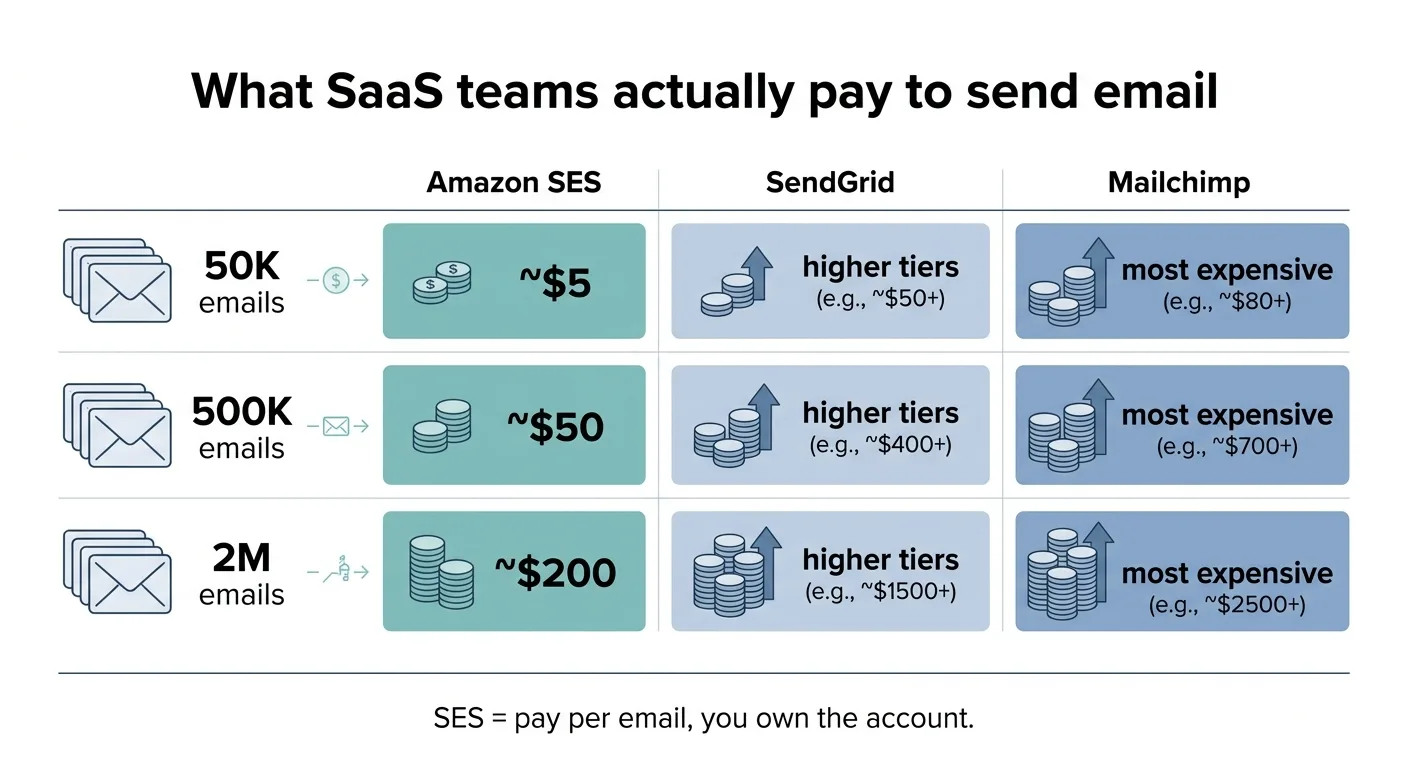
SES bills only for the bytes you send, which is why it lands far below the subscription tiers at the same volume.
Amazon SES pricing vs SendGrid and Mailchimp at the same scale
This is where the ownership argument gets concrete. Send-as-a-service tools charge a subscription that bundles infrastructure, a dashboard, and support. SES charges only for the bytes. At 500,000 emails a month, the difference is large.
| Provider | Model | Rough cost at 500,000 emails/mo |
|---|---|---|
| Amazon SES | Pay per email, own your account | About $50 (send only), plus your own tooling |
| SendGrid | Tiered subscription by volume | Higher volume tiers run into the hundreds per month |
| Mailchimp | Contact-based subscription | Priced on audience size, typically the most expensive at scale for transactional-style volume |
Verify the current numbers before you decide, because SendGrid and Mailchimp change their tiers; our comparison of SendGrid alternatives by monthly cost was rechecked against each vendor's pricing page in October 2026. But the shape is stable and has been for years: SES is the cheapest way to move email at volume by a wide margin, because you are paying wholesale for infrastructure instead of retail for a product. Reddit threads where founders share their real SES invoices consistently show sub-dollar monthly bills for small apps and low double digits for busy ones. Mailchimp in particular is built for audience-based marketing and gets expensive fast for high-frequency product email, which is a different job. That is not a knock on Mailchimp: it is the wrong tool priced for the wrong use case if all you need is reliable transactional and lifecycle sending.
What the cheap price does not include
The $0.10 per 1,000 buys you delivery attempts. It does not buy you any of the things a marketing platform includes in its subscription, and this is the honest cost you are trading against.
- No campaign or template builder. SES sends raw email you construct. There is no drag-and-drop composer, no saved templates library beyond basic API templates.
- No lifecycle automation. SES will not send a welcome series on signup or a win-back on cancellation. It has no concept of a user, a trigger, or a sequence. It sends what your code tells it to, when your code tells it to.
- No engagement analytics you can read. SES emits raw events (delivery, bounce, complaint, open, click) through SNS, but there is no dashboard showing you open rate by campaign. You wire those events into your own store and build the reporting.
- New accounts start in a sandbox. Every new SES account can only send to verified addresses, capped low, until you request production access and a sending-quota increase. Plan for that approval step. Our Amazon SES setup walkthrough covers getting out of the sandbox cleanly.
- You own reputation and warm-up. No provider babysits your sender reputation for you. If you blast a cold list on day one, you can burn a new IP or domain. A slow warm-up is on you.
None of this makes SES a bad choice. It makes SES an infrastructure choice. You get the lowest per-email cost in the market and full control, and in exchange you supply the layer that turns raw sending into product email.
Amazon SES is the cheapest way to move email at volume. The bill you should worry about is not the $0.10, it is the engineering time to build everything the price does not include.
The ownership angle: why teams move onto their own SES anyway
Here is the strategic reason founders keep choosing SES despite the missing layer. When you send through a hosted send-as-a-service platform, that platform owns your sending reputation and can throttle, pause, or price you at their discretion. Your deliverability is a tenant on their infrastructure. When you send on your own AWS SES account, you own the sending identity, the reputation you build, and the cost curve. Nobody between you and the inbox can hold your list hostage or change your unit economics overnight.
That is the whole ownership thesis, and it is a durable one. The trade is real: you take on setup and monitoring in exchange for control and near-wholesale pricing. The teams that make this trade are usually the ones that got a surprise bill or a sudden deliverability drop on a hosted tool and decided they never wanted their sending to be a bargaining chip in someone else's business again.
The catch is the missing product layer, and that is the specific gap Meisa was built to fill. Meisa runs lifecycle sequences, broadcasts, A/B tests, and true open-rate analytics (it separates human opens from scanner opens like Apple Mail Privacy Protection and Mimecast) directly on top of your own AWS SES account. You keep the $0.10-per-1,000 SES economics and the ownership, and you get the campaign builder, the behavioral triggers, and the readable analytics that raw SES does not include. If you would rather not build and maintain that layer yourself, that is the point of it. There is also a managed mode if you want Meisa to handle the SES side entirely. You can weigh it against other options in our best email tools for SaaS roundup, where SES-based sending is one honest choice among several.
How to actually estimate your bill
Skip the guesswork and use two inputs: your monthly send volume and whether you need a dedicated IP.
- Multiply your monthly sends by $0.0001 (that is $0.10 per 1,000). 200,000 emails is $20. That is your floor.
- Add attachment cost only if you send attachments. Most product email does not. If you attach PDF invoices, estimate total attachment GB per month times $0.12.
- Add a dedicated IP ($24.95) only at sustained high volume. Below roughly 100,000 emails a week to an engaged list, skip it. A cold dedicated IP hurts more than it helps.
- Add VDM ($0.07 per 1,000) if you want AWS-native deliverability monitoring. Many teams instead get that visibility from the product layer on top of SES, so this is optional.
- Budget for your own tooling. Either engineering time to build the automation and analytics layer, or a subscription for a tool that provides it. This, not the SES line item, is usually the real cost.
Run those five steps and you will have a number that survives contact with your actual invoice, which is more than the "$0.10 per 1,000 and done" articles will give you.
FAQ
What is the cost of Amazon SES?
Amazon SES costs $0.10 per 1,000 emails you send, verified on the AWS SES pricing page in 2026. You also pay $0.12 per GB of attachment data, and if you receive email, $0.10 per 1,000 inbound plus $0.09 per 1,000 incoming mail chunks. There is no monthly base fee, so a small app often pays under a dollar a month.
Is Amazon SES free?
There is a limited free tier: new AWS customers get up to 3,000 message charges free each month for the first 12 months of using SES. After that, or above 3,000, you pay the standard $0.10 per 1,000. The older "62,000 free emails from EC2" tier is legacy and should not be used for current cost planning.
Why is Amazon SES so cheap?
Because SES sells raw sending infrastructure, not a product. You pay wholesale for delivery attempts and supply everything else yourself: templates, automation, analytics, warm-up, and reputation management. Subscription tools cost more because their price bundles that whole product layer plus support.
How much does Amazon SES cost per month for a SaaS?
For most SaaS teams, $5 to $200 a month for the raw send, depending on volume (50,000 emails is about $5, two million is about $200). Add $24.95 per dedicated IP only at sustained high volume, and $0.07 per 1,000 for the Virtual Deliverability Manager if you want it. The larger real cost is the tooling layer on top.
Do I need a dedicated IP on Amazon SES?
Usually not until you are sending consistent high volume, roughly hundreds of thousands of emails a week to an engaged list. Below that, the shared IP pool gives better deliverability because a low-traffic dedicated IP cannot build enough reputation. Adding a dedicated IP too early is a common and costly mistake.
Is Amazon SES pricing cheaper than SendGrid?
Yes, at volume, and by a wide margin. SES charges per email with no subscription; SendGrid and Mailchimp charge tiered or contact-based subscriptions that run into the hundreds per month at scale. The trade is that SES gives you no dashboard or automation, so you either build that layer or run a tool on top of your SES account.
The bottom line
Amazon SES pricing is genuinely $0.10 per 1,000 emails, and for a SaaS team that usually means a raw send cost of $5 to $200 a month, far below SendGrid or Mailchimp at the same scale. The real cost is not the SES line item. It is the automation, analytics, and warm-up layer that the price deliberately does not include, and the ownership that setup buys you.
If you have decided SES is the right economics but you do not want to build the product layer by hand, the fastest path is to run a lifecycle-and-broadcast tool on top of your own SES account so you keep the pricing and the ownership while skipping the engineering. Start with the Amazon SES setup walkthrough to get your account production-ready, then read the email deliverability guide so your cheap, owned sending actually reaches the inbox.
Frequently asked questions
What is the cost of Amazon SES?
Is Amazon SES free?
Why is Amazon SES so cheap?
How much does Amazon SES cost per month for a SaaS?
Do I need a dedicated IP on Amazon SES?
Is Amazon SES pricing cheaper than SendGrid?
About the author
Junaid Khalid
Lifecycle Email Specialist
I run lifecycle and broadcast email for eight SaaS products on my own AWS SES, reaching 15,000+ users: onboarding sequences, behavior-triggered sends, and broadcasts that reach the inbox without getting flagged. These articles cover deliverability, triggers, and what actually moves activation and retention.